Progress (or lack there of):
The weather in our region is very cold these days, and it is expected to last for at least 14 days.
As a result, our ventilation aggregate stopped working again the other day (-13C). It seems as though temperatures below -10C causes build up of ice inside the rotating heat-exchanger and the aggregate stops working (the alarm flashing on the display says "Rotor"). The ventilation subcontractor has been notified, but we are still waiting for them to fix this and other remaining issues.
Dispite the fact that the project has not been completed and formally "handed over" to us, they sent us the remaining invoices on December 23rd. I immediately contacted the project leader and told him that we accept to pay for the other work - but the last invoice for the ventilation system (ca 10.000 USD) will not be paid until the solution has been delivered according to the contract.
Note: The updates on this blog have not come as frequently as they used to. First we had Christmas Eve and Christmas Day, and the last couple of days we have been skiing in the norwegian mountains (at Beitostoelen).
Comments:
Until our own JAHUS project has finished - I will continue to write updates when there is progress to report. There will also be more on the economics of this project. Initial calculations indicate that our project will have a paybacktime of approximately 12 years. With more fine-tuning others who want a JAHUS project should be able to get almost the same CO2/energy savings with a paybacktime of 10 years. More on these calculations and suggestions on how to achieve the same benefits and a paybacktime of only 10 years in future blog-posts.
"The job isn't done...."
COP15 in Copenhagen didn't give us what we had hoped for. In the next 12 months we will continue to see development and discussons on the unresolved issues (China letting UN monitor what they do, USA to pass a new climate law, who pays for what etc.). As we enter into a new year, I will also continue to update this blog with information on topics related to global warming and energy-saving.
Tuesday, December 29, 2009


Monday, December 21, 2009
After Copenhagen - now what?
Comments: not done yet
The climate meeting in Copenhagen ended, as feared, without the big breakthrough. The result was a sort of declaration to continue work, and at least that is something.
The U.S. and other rich countries were blamed for the failure in Copenhagen. I think the toughest COP15 critics oversimplyfy what in reality is very difficult political questions.
1) It was an error to put a lid on the scientific debate about climate change: instead, one should be much more open about the uncertainty, but also remind people that the uncertainty could mean that things are worse than the models indicate. We should view the measures to reduce emissions of greenhouse gases as an insurance. (Insurance is something we pay for even if we do not know for sure that something goes wrong.)
2) It will be expensive: One can compare the cost to the entire world's GDP, and say that it is not going to cost us much. The burden, however, will not be evenly distributed and it will definitely change the lives of many people. Are these efforts going to result in major transfer of resources from developed- to developing countries?
3) The distinction between the "rich nations" and the rest is also too easy. It was also one of the major problems with the Kyoto Protocol (in addition to the United States never ratified it): no restrictions were imposed on most countries in the world, also relatively rich countries, such as South Korea. The same was true for rapidly growing economies such as China, which in the meantime has become the world's largest emission source.
(Thanks to Are Slettan for input)
Progress:
As mentioned in my previous blog post, the ventilation aggregate stopped working around noon on Saturday. Later on that same day, the outside temperature increased to -7C (from -12C) and I decided to start the aggregate again. This time it worked - and I told the ventilation team that it seems like the aggregate has problems below -10C. This is of course not an acceptable limitation in a country like ours where we can expect -10C in December, January, February and occationally even in March. It is now 4 pm on Monday and they have not responded or showed up to finish the work...
In my email I also asked for an update on when the electrician is planning to connect the new fans - to get the flow of heated air into the ventilation system. He didn't come on Friday, but the projectleader responded per email on Sunday saying "The electrician is coming tomorrow!".
Around noon today I received a phonecall directly from the electrician - and he said he could not make it today. I told him what the project leader had promised me, but he insisted that he could not come today.
I sent a frustrated mail back to the project leader: "Did just hear that Morten is not coming today (so now we see how much your promises, with exclamation points, are worth) ..."
He responded very quickly: "I spoke with Runar now, he promised to call Morten and tell him to stop by today! He will call you back. " (Runar is the manager). Does anyone believe that the electrician called me back or showed up?
Friday, December 18, 2009
Final day of negotiations in Copenhagen
Event: A Copenhagen Accord it is
An agreement drawn up Friday night by leaders from the US, China, India and South Africa has been recognized Saturday morning by the Parties to the UN Framework Convention on Climate Change.
The three-page document, which would not be binding in international law, dropped a final paragraph in a previous draft that had said that negotiations on a full, legally binding treaty would have to be completed by the end of 2010.
The text stuck to previous goals, including one of limiting world temperature rises to a maximum rise of 2 Celsius above pre-industrial times to avert impacts such as floods, heat waves, species extinctions and rising ocean levels.
The draft still left blank key elements such as the depth of cuts in greenhouse gas emissions expected of developed nations by 2020.
http://en.cop15.dk/news/view+news?newsid=3070
Comments: What was agreed at Copenhagen – and what was left out
National leaders and sleep-deprived negotiators thrashed out a text late last night that could determine the balance of power in the world and possibly the future of our species. A useful breakdown of the key points is provided at the following web-site:
http://www.guardian.co.uk/environment/2009/dec/18/how-copenhagen-text-was-changed
Comments: Copenhagen climate conference: global warming talks meltdown
The Bella Centre in Copenhagen looks more like the aftermath of a particularly messy house party rather than the place where 120 of the most powerful men and women have just met to discuss saving the planet.
Obama said “Yes we can!”
Umm, actually no we can’t.
It soon became clear that China was not signing up to any treaty that allowed other countries to snoop around in their dirty emissions laundry. Chinese Premier Wen Jiabao reportedly left for his hotel in a huff and suddenly the whole conference was plunged into chaos.
What really happened - and why?
http://www.telegraph.co.uk/earth/copenhagen-climate-change-confe/6843154/Copenhagen-climate-conference-global-warming-talks-meltdown.html
Progress:
The carpenter came to our house yesterday and he removed the "doghouse" (that covers the heatpump), but to our surprise it didn't make the noice go away. The problem must be the heatpump itself or the way it is connected to the house. The team who installed it has promised to fix it (but did not show up yesterday).
The electrician didn't come on Friday and we therefore still can't try the JAHUS solution (with heated air added after the aggregate). At the moment it is -12C outside, and the fresh air that is delivered to the livingroom is only 7C (!).

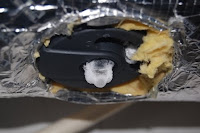
 The pictures show that the pipe that is used for sending the exhaust air out of the house, is full of condensated- and partly frozen water (the exhaust air is -3C).
I hope they will wrap this pipe in isolation material too, to fix the problem.
To add to our frustration, the aggregate stoppped working this morning (Saturday). It started making noices and I had to pull the plug. When I restarted the aggregate, the heat-exchanger didn't rotate and that was the cause of the noices from the aggregate. I therefore pulled the plug again and emailed the project leader and the subcontractor - telling them that we are currently without a working ventilation system. With Christmas only days away, I really hope that they take this seriously on Monday.
Thursday, December 17, 2009
Progress - in Copenhagen and in our JAHUS
Event 1: Video clip
As world leaders arrived in Copenhagen yesterday, a nice videoclip was released to further highlight the need for serious committments from both developed- and developing countries. Watch the video clip here:
http://www.youtube.com/watch?v=t6Nc18O4E38&feature=player_embedded
Event 2: Back to work
United Nations talks on fighting climate change finally turned to the details of how to combat global warming on Thursday after 36 hours of wrangling over procedural issues. Officials expressed relief that the procedural row had ended at last, but warned that the dispute had wasted precious time just a day away from the end of the conference.
"I would say: hold tight and mind the doors, the cable-car is moving again," the UN's chief climate negotiator, Yvo de Boer, told journalists in Copenhagen.
Progress:
 Today they finally installed the connection between the pipe with heated air from the heatpump (the pipe in the lower right side of the picture) and the pipe that blows fresh air from the aggregate to the distribution network in the house (the pipe in the upper left corner of the picture). The new setup is exactly what I asked for in an earlier blog post (and in discussions with the subcontractor). The design is also illustrated in my technical sketch which is attached below.
As shown in the picture above, the new setup includes a fan (the lump on the connection between the two pipes) - and because the electrician hasn't connected the fan to the electrical grid in the house, the functionality can not yet be verified. I hope that we can test it for the first time tomorrow and publish some results during the weekend.
Tomorrow the carpenter has promised to move/adjust the "doghouse" that was built around the heatpump (outside). We believe the current construction is causing more noice than normal from the heatpump - because the "doghouse" is attached to the outside wall and probably transmits vibrations to the house.
It is -10C in Kolbotn now and the exhaust air is therefore below zero (C). As I expected, there is condensated water building on the un-isolated pipe as shown in the next picture. I have forwarded this picture to the ventilation experts and told them that I believe that this particular pipe should be isolated. The last picture was included to illustrate how cold one of the valves is under such conditions.


As world leaders arrived in Copenhagen yesterday, a nice videoclip was released to further highlight the need for serious committments from both developed- and developing countries. Watch the video clip here:
http://www.youtube.com/watch?v=t6Nc18O4E38&feature=player_embedded
Event 2: Back to work
United Nations talks on fighting climate change finally turned to the details of how to combat global warming on Thursday after 36 hours of wrangling over procedural issues. Officials expressed relief that the procedural row had ended at last, but warned that the dispute had wasted precious time just a day away from the end of the conference.
"I would say: hold tight and mind the doors, the cable-car is moving again," the UN's chief climate negotiator, Yvo de Boer, told journalists in Copenhagen.
Progress:
 Today they finally installed the connection between the pipe with heated air from the heatpump (the pipe in the lower right side of the picture) and the pipe that blows fresh air from the aggregate to the distribution network in the house (the pipe in the upper left corner of the picture). The new setup is exactly what I asked for in an earlier blog post (and in discussions with the subcontractor). The design is also illustrated in my technical sketch which is attached below.
As shown in the picture above, the new setup includes a fan (the lump on the connection between the two pipes) - and because the electrician hasn't connected the fan to the electrical grid in the house, the functionality can not yet be verified. I hope that we can test it for the first time tomorrow and publish some results during the weekend.
Tomorrow the carpenter has promised to move/adjust the "doghouse" that was built around the heatpump (outside). We believe the current construction is causing more noice than normal from the heatpump - because the "doghouse" is attached to the outside wall and probably transmits vibrations to the house.
It is -10C in Kolbotn now and the exhaust air is therefore below zero (C). As I expected, there is condensated water building on the un-isolated pipe as shown in the next picture. I have forwarded this picture to the ventilation experts and told them that I believe that this particular pipe should be isolated. The last picture was included to illustrate how cold one of the valves is under such conditions.


Wednesday, December 16, 2009
Interest rates and global warming?
Comments:
Strong domestic economy caused the norwegian central bank to increase interest rates by 0,25% today, dispite the fact that a stronger local currency will make it even harder for the export industry to compete in the global market.
So, why do I talk about a relationship between interest rate policies and global warming? When you need to tighten the domestic economy to prevent inflation - isn't adding more tax to the cost of electricity a good alternative (or supplement) to the frequent increases in interest rates ? Increasing taxes on electricity will not only curb inflation, but it will speed up the adoption of energy saving projects - and it will also have an element of distributive politics (people who own the biggest houses pay the most). Such a measure will not strengthen the exchange rate in the same way, and hence will not aggravate the situation for the export industry.
Should energy saving measures provide some environmental benefit, Norway must also increase the export capacity of the power grid (multiple cables to Europe). If no excess power can be sold to Europe, supply of electricity will exceed demand and prices will plunge.
Many people have recently argued that we must avoid adding to the capacity of the transmission of electricity between Norway and the rest of Europe. They say that synchronizing the prices of electricity with the rest of Europe is a bad thing - and is only being pushed by profit-hungry power companies. Electricity prices that Norwegian industry must pay is currently below the level their competitors out there pay. They should be able to make a profit with European electricity prices (or move production to where it can be produced at competitive prices). Private households will have less money to spend (and drive inflation) either way - tax on electricity or higher interest rates. As a reminder, look to the United States and what artificially low gasoline prices did to the use of cars. At the other end of the spectrum, look to Europe to see what high energy prices have done to the daily routines like switching off the lights when you leave a room (if you don't move quickly up the stairs, the lights are switched off automatically before you get to the next level).
In addition, there are other more technical arguments why we need to add more cables between us and Europe. This fall, we had two examples of large quantities of clean energy that was lost because we lacked the capacity for the exchange of energy between Denmark and Norway. In Denmark there was a storm and since this happened over a weekend, it was not enough demand for power in the grid - and they simply had to disconnect the wind turbines from the power grid (a grid that does not have the ability to store energy). That same week, there was a story on the TV2 News that the local power company (BKK) had to let the water in reservoirs flow outside the turbines - because they produced too much power and magazines could not be filled more.
When there is no wind in Europe, they should be able to draw on hydropower from Norway (which we can save and "let go" when it suits us). Similarly, they should be able to export energy to us when the wind generates "too much" power - because we can use this energy to pump water up to the reservoirs (where the energy can be saved and released again when there is no wind in Denmark or overcast in Spain - so that the solar powerplants do not produce electricity).
Events:
More than a 100 world leaders have now arrived in Copenhagen and take over for the environment ministers.
The demonstrations outside continue and so does the talk of police brutality.
Inside the COP15 building, there seems to be a bigger gap between the developed- and the developing countries than when they started the negotiations a week ago. There are still many challenges that the delegations must face before they can leave on Friday - with the results we all hope for.
Progress:
Only 2 days until they promised to have all the extra ventilation work done (new fan, adding the heated air after the aggregate, reducing noice) - but nothing was done today either.
Tuesday, December 15, 2009
There is light at the end of the tunnel - is it a train?
Event 1: Walkout heightens failure fears for climate marathon
Negotiators worked through the night Tuesday to prevent a UN climate summit from ending in catastrophic failure after developing nations staged a five-hour walkout and China accused the West of trickery.
http://uk.news.yahoo.com/18/20091214/twl-walkout-heightens-failure-fears-for-6d10327.html
 Event 3: Green protest on Sydney Opera House
Greenpeace activists climb the Sydney Opera House to get their message across to the world leaders - only a short week away from the closing of the conference.
http://uk.news.yahoo.com/22/20091215/video/vwl-green-protest-on-sydney-opera-house-d7f4ae7.html
Progress:
The ventilation subcontractor said: "I am waiting for the delivery of sound absorbers. These will help significantly on the noise. I'll check with the refrigeration engineer - there may be something to do with the noise from the heat pump. We should be fully assembled during this week".
The electrician is in the house today and will install the regulator for the fan that drives the "extra loop" (supply of cooler air to the bedrooms). Hopefully he will also make it easy for the ventilation team to install the extra fan downstairs. That fan will pull heated/cooled air from the area near our heatpump and blow it into the stream of fresh air (after the aggregate). This air-mixture is then distributed around the house from the attic.
Negotiators worked through the night Tuesday to prevent a UN climate summit from ending in catastrophic failure after developing nations staged a five-hour walkout and China accused the West of trickery.
http://uk.news.yahoo.com/18/20091214/twl-walkout-heightens-failure-fears-for-6d10327.html
Event 2: More specifically China versus USA
China, which last month for the first time publicly announced a target for reducing the rate of growth of its greenhouse gas emissions, is refusing to accept any kind of international monitoring of its emissions levels, according to negotiators and observers. The United States is insisting that without stringent verification of China’s actions, it cannot support any deal.
http://www.nytimes.com/2009/12/15/science/earth/15climate.html?_r=1&ref=energy-environment
 Event 3: Green protest on Sydney Opera House
Greenpeace activists climb the Sydney Opera House to get their message across to the world leaders - only a short week away from the closing of the conference.
http://uk.news.yahoo.com/22/20091215/video/vwl-green-protest-on-sydney-opera-house-d7f4ae7.html
Progress:
The ventilation subcontractor said: "I am waiting for the delivery of sound absorbers. These will help significantly on the noise. I'll check with the refrigeration engineer - there may be something to do with the noise from the heat pump. We should be fully assembled during this week".
The electrician is in the house today and will install the regulator for the fan that drives the "extra loop" (supply of cooler air to the bedrooms). Hopefully he will also make it easy for the ventilation team to install the extra fan downstairs. That fan will pull heated/cooled air from the area near our heatpump and blow it into the stream of fresh air (after the aggregate). This air-mixture is then distributed around the house from the attic.
Monday, December 14, 2009
Developing = poor?
Comments: Developing = Poor?
At the COP15 the press is constantly referring to a fight between the developed countries and the developing countries. Developed countries have caused the problem by occupying most of the available "CO2 space" and should therefore pay for most of the efforts to reduce CO2 emissions in developed and developing countries.
People seems to think of developing countries as poor countries - but is this always true? Today there seems to be only one nation with huge amounts of cash, China (categorized as a developing country). A leading developed country USA borrows money from China to finance its budget deficit. When USA is going to pay big bucks to developing countries for CO2 reduction programs - it will be with borrowed money from China.
If you play with this thought, it might get scary... If you get into trouble financially (or otherwise) and live in Sicily or in New York -the Mafia is more than happy to help you. There is a catch, however, they will some day "ask" for a favour in return. The more you owe them, the harder it will be for you to pay them back.
The blue-suits know more about this dilemma, but through history we have seen many South American countries with huge debts - and at that time they borrowed from USA. Hyperinflation and frequent devaluations reduced the debt - how will USA be able to pay China back? My guess is that we'll either see inflation or big budget cuts (or both).
 Event 1: More than 200 activists detained Sunday.
Danish police stopped an unauthorized demonstration on a second day of street protests over climate change as environment ministers met for informal talks to advance negotiations on a new pact.
These arrests follow the 968 people detained during and after a mass rally Saturday in Copenhagen. (Police said only 13 of them remained in custody Sunday. Of those, three were set to be arraigned in court on preliminary charges of fighting with police).
Event 2: Gahr and Gore
Former American Vice President Al Gore and Norwegian Foreign Minister Jonas Gahr Støre will present their global report on melting ice during a side event of the UN Climate Change Conference in Copenhagen (COP15) today - "Melting of the polar regions occurs much faster than experts previously thought. Sea may rise two feet over this century."
Progress:
Nobody showed up to finish the work today either.
Subscribe to:
Posts (Atom)

 Posts


